Chapter 4
The Controlled Division of Labour Between Humans and AI
Last updated: 2026-04-10 Open for review
The three preceding chapters have established the constitutional foundations: the governance crisis created by the gap between enacted law and digital execution (Chapter 1: The Governance Crisis in the Age of AI), the vision of law as public digital infrastructure (Chapter 2: Government as an Operating System --- The Vision), and the principle of separation between AI capability and normative authority (Chapter 3: The Principle of Separation --- Why AI Must Not Decide the Law). Chapter 3 introduced three models of AI participation in legal governance, each placing the constitutional line at a different point. This chapter develops the operational consequences: how the division of labour between humans, AI systems, and the normative infrastructure is structured in each model, and what “controlled” means when applied to a system in which machines participate in the exercise of public power.
Executable Code as the Machine-Readable Form of Human Intent
To understand the constitutional significance of the Decision Tree, it is necessary to be precise about what kind of artefact it is. It is not general-purpose software. It is not an AI model. It is not a business rules engine operating on internally defined logic. It is a formally specified executable representation of human intent: specifically, the democratic intent of a legislature, expressed through the statutory provision the Decision Tree implements.
The provenance of this intent is the foundation of the OLRF’s entire constitutional architecture. A legislature enacts a statute. That statute embodies choices: about who deserves a benefit and under what conditions, about what constitutes a regulatory violation, about how competing interests are to be balanced. These choices are political. They reflect values, compromises, and the democratic will of the community as expressed through its elected representatives. They are the source of the law’s binding force. And they are, in the OLRF architecture, the source of the Decision Tree’s authoritative content.
When a responsible authority constructs a Decision Tree for a statutory provision (tracing each element to its sub-normative anchor in the statutory text, classifying each portion of the norm in the Coverage Map, specifying the types and sources of every fact the tree requires) it is performing a translation: from the language of democratic deliberation into the language of machine execution. This translation is not an act of creation. It is an act of interpretation, the same interpretive act that has always been required to move from enacted text to administrative practice. What changes is the explicitness of the interpretation, the verifiability of its connection to the text, and the accountability of the translator.
This understanding of the Decision Tree is constant across all three models proposed in this paper. What changes is the function the tree performs.
The Variable Role of the Decision Tree
In Model A (deterministic evaluation), the Decision Tree is the evaluator. It receives validated facts and applies the normative logic to produce a binding determination. The AI system’s role is strictly confined to assembling, validating, and submitting the facts. The tree executes. The AI serves.
In Model B (guided evaluation), the Decision Tree is the validator. A qualified Legal Agent performs the subsumption, reading the statutory text, interpreting its terms in context, and producing a determination. The Decision Tree then serves as the normative framework against which the agent’s result is checked. Where the agent’s determination is consistent with the tree’s structure, the validation confirms it. Where it deviates, the deviation is documented, flagged for review, and either justified by the agent’s reasoning or escalated for human decision. The tree does not decide. It verifies.
In Model C (autonomous legal reasoning), the Decision Tree is the audit protocol. A highly qualified Legal Agent applies the statutory text directly, without using the tree for evaluation or validation during the decision process. The tree is consulted retrospectively: the agent’s determination is documented against the tree’s structure to produce a transparent, auditable record of how the norm was applied. The tree does not decide and does not verify. It makes visible.
This progression (from evaluator to validator to audit protocol) is not a weakening of the Decision Tree’s constitutional function. It is a shift in the mechanism through which the function is performed. In every model, the tree ensures that the normative basis of the determination is publicly specified, traceable to the legislative text, and available for review by courts, auditors, and citizens. The instrument changes. The constitutional commitment it serves does not.
Where the Decision Actually Happens
An honest account of the division of labour must address a feature of the architecture that is easily overlooked: the primacy of fact framing.
In all three models, the factual record that reaches the normative layer (whether Decision Tree, Legal Agent, or both) has been assembled, interpreted, and structured by an AI system. The AI system has decided that the applicant’s income is 11,800 euros (and not 12,200, which a different classification of certain payments would have produced). It has decided that the living situation qualifies as “living alone” (and not as “shared household,” which a different reading of the accommodation records would have supported). It has decided which of several possible interpretations of an ambiguous document is correct.
These are not mechanical extraction tasks. They are interpretive acts that shape the outcome. The Decision Tree in Model A receives these interpreted facts and evaluates them deterministically. But the evaluation is only as good as the facts it receives. The agent who frames the facts exercises a form of influence over the outcome that is real, significant, and (if the architecture does not make it visible) potentially unchecked.
This paper proposes that fact framing must be treated as what it is: the most critical step in the entire process, not only a preparation to the “real” decision. Three architectural consequences follow.
First, the DataPoint Schema must require the agent to document not only the value of each fact but also the interpretive choice that produced it: which source was consulted, which alternative readings were considered, and what confidence level the agent assigns to its classification. A fact delivered without this documentation is an assertion. A fact delivered with it is a reasoned finding, reviewable on its own terms.
Second, the Agent Capability Attestation (developed in the security model as Control 5) must be understood not as a secondary safeguard but as the most important quality gate in the architecture. If the agent controls the facts and the facts determine the outcome, then the competence and integrity of the agent is the single most consequential variable in the system, more consequential, in practical terms, than the correctness of the Decision Tree itself.
Third, the validate_facts interface must go beyond type checking and format compliance. It must assess whether the agent’s interpretive choices are consistent with the DataPoint schema’s source requirements, whether the confidence levels are plausible given the source material, and whether the pattern of fact framing across a population of cases suggests systematic bias. This population-level monitoring (analogous to the rubber-stamping detection described for Discretion Points) is the architectural safeguard against a risk that is inherent in every model: that the agent, intentionally or unintentionally, steers outcomes through the selection and interpretation of facts rather than through normative evaluation.
The Three-Layer Architecture Across Three Models
The OLRF proposes a division of labour among three types of actors. The specific responsibilities of each actor shift depending on the model, but the constitutional logic remains constant: different types of authority require different types of actor.
Layer One: AI Agents.
In Model A, AI agents operate exclusively in the domain of facts. They find, extract, validate, and structure the empirical information that the Decision Tree needs to execute. This is work that requires the kind of capability AI systems possess in abundance: the ability to process unstructured documents, to reason about natural language descriptions of circumstances, to identify relevant information in complex and ambiguous inputs, to maintain coherent state across extended multi-step workflows. It is also work that is constitutionally safe for AI to perform, precisely because it does not determine legal outcomes.¹⁸
In Model B, AI agents go further. They perform the normative subsumption itself, applying the statutory text to the established facts and producing a determination. This determination is then validated against the Decision Tree’s structure. The agent’s role expands from fact-preparer to guided evaluator, but it remains bounded: the tree provides the normative framework, and deviations require justification.
In Model C, AI agents perform the full range of legal reasoning, from fact-finding through interpretation to determination. Their role is closest to that of a human jurist. The constitutional constraints on this role (verifiability, auditability, consistency) are the most demanding, and as discussed in Chapter 3, they cannot currently be satisfied with the rigour that binding legal decisions require.
Layer Two: The Normative Infrastructure.
The Decision Tree, the Coverage Map, the sub-normative linkage, the DataPoint Schema, and the Registry together form the normative infrastructure of the OLRF. Their collective function shifts across models.
In Model A, the normative infrastructure is the decision-maker. The deterministic evaluation engine applies the tree’s logic to the submitted facts and produces a signed determination. Equal treatment is guaranteed by the engine’s deterministic execution semantics: the same facts always produce the same outcome.
In Model B, the normative infrastructure is the quality framework. It defines the structure against which the agent’s reasoning is validated, makes deviations visible, and provides the reference point for judicial review. Equal treatment is supported (though not guaranteed in the strict deterministic sense) by the consistency monitoring that the validation framework enables.
In Model C, the normative infrastructure is the transparency instrument. It documents the agent’s determination retrospectively, makes the normative basis visible, and provides the audit trail that courts and oversight bodies require. Equal treatment depends primarily on the quality and consistency of the agent, with the tree serving as the benchmark against which consistency is measured.
Layer Three: Humans at Discretion Points
Across all three models, wherever the applicable statutory provision confers judgment on a human official, the process pauses. The AI agent layer has assembled the facts. In Model A, the Decision Tree has evaluated all deterministic conditions. In Models B and C, the agent has prepared the determination up to the point where human judgment is required. What remains is a judgment that the legislature has, deliberately and constitutionally, reserved for human exercise.
The official is presented with the complete factual record, the AI-generated Assistance Package (where the Discretion Point is configured for AI assistance), and the structured reasoning record that proper discretionary exercise requires. The official exercises their discretion, documents their reasoning, and returns the determination to the process. The Decision Package is completed and signed.
The Discretion Point architecture is not a concession to technical limitations. It is a constitutional design choice: a formal commitment that wherever the legislature has reserved a decision for human judgment, the automated system will enforce that reservation rather than circumventing it. This commitment is constant across all three models. A workflow that attempts to skip a Discretion Point cannot produce a valid, signed Decision Package in any model, because the normative infrastructure will not sign a package with an unresolved Discretion Point.
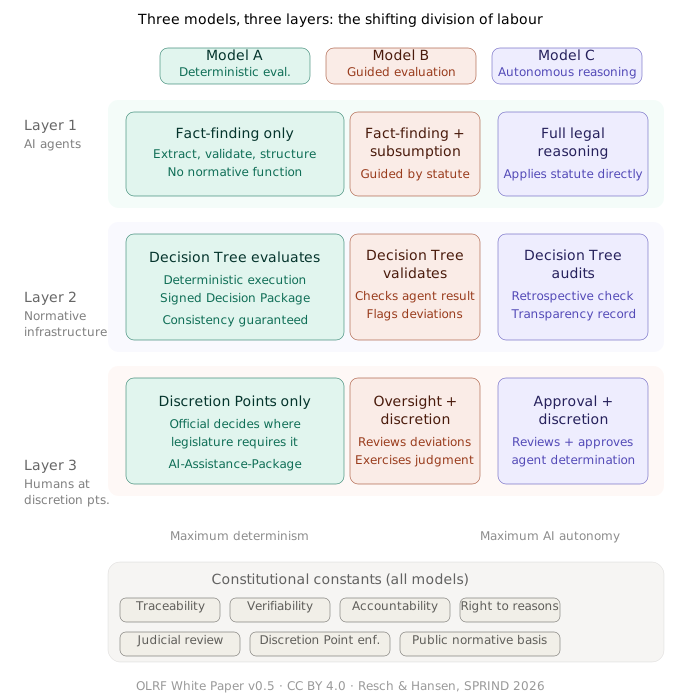
Figure 1: Human — AI - the shifting division of labour
What “Controlled” Means
It is not sufficient for the division of labour to be intended or aspired to. It must be architecturally enforced: built into the system in a way that makes violation structurally visible and, where possible, technically impossible.
The OLRF proposes three enforcement mechanisms that operate at different levels.
At the interface level, the normative layer is read-only with respect to all AI clients. No AI system can modify the Decision Tree, alter the Coverage Map, or produce a signed Decision Package without a genuine evaluation by the normative infrastructure. This constraint applies in all three models. In Model A, it prevents the agent from bypassing the deterministic evaluation. In Model B, it prevents the agent from overriding the validation result. In Model C, it prevents the agent from fabricating an audit record that does not correspond to the actual determination.
At the evaluation level, the enforcement mechanism differs by model. In Model A, deterministic execution semantics ensure that the same facts always produce the same outcome. In Model B, the validation framework ensures that deviations between the agent’s determination and the tree’s structure are documented and reviewable. In Model C, the retrospective audit ensures that the agent’s determination is permanently recorded against the normative structure.
At the audit level, the composite audit trail (the cryptographically verifiable record of every agent action, every fact submission, every evaluation, and every Discretion Point resolution) ensures that the division of labour cannot be circumvented after the fact through selective documentation. This mechanism is identical across all three models.
“Controlled” means that the control is structural, not behavioural. The OLRF does not rely on AI systems being well-aligned, well-instructed, or well-intentioned. It proposes a framework in which the constitutional boundaries are made visible, verifiable, and (to the maximum extent that each model permits) technically enforceable.
Constitutional Separation of Powers: Preserved, Not Altered
The deepest concern that any proposal for AI-assisted governance must address is its relationship to the constitutional principle of separation of powers. Does the OLRF, by enabling AI systems to participate in administrative processes, alter the balance between the three powers of government?1 2
This paper proposes that it does not. The argument holds across all three models.
The Legislature: Strengthened, Not Weakened
The OLRF creates, for the first time, a formal mechanism through which the legislature’s intent can be expressed not merely in statutory text but in a machine-applicable normative specification, in a form that is verifiable, auditable, and permanently traceable to the legislative act from which it derives. A legislature that publishes Decision Trees alongside its statutes is not delegating its authority to a machine. It is extending the reach of its authority into the operational reality of digital administration, reaching past the private interpretations of software developers and ensuring that what the system applies is what the parliament enacted. The dual publication model gives the legislature new tools of democratic control over implementation, regardless of which model is used for the actual application.
The Executive: Clarified, Not Displaced
Administrative officials who use OLRF-enabled systems are not replaced by those systems. In Model A, officials are freed from deterministic processing to concentrate on Discretion Points. In Model B, officials work alongside Legal Agents, exercising oversight and judgment where the agent’s reasoning requires human validation. In Model C, officials review and approve agent determinations before they become binding. In every model, human judgment is concentrated where it matters most rather than dissipated across routine cases where human involvement adds no constitutional value.
The Judiciary: Reinforced, Not Circumscribed
Administrative courts reviewing OLRF-based determinations have, for the first time, access to the complete reasoning record of every automated determination: the Decision Package, the normative specification it was evaluated against, the sub-normative linkage connecting every element to the statutory text, the Coverage Map documenting the scope of automation, and (where applicable) the Discretion Point record documenting every exercise of human judgment. Courts retain full authority to assess whether the norm was correctly interpreted, whether the facts were correctly established, and whether discretion was lawfully exercised. What changes is the quality of the material on which that assessment can be conducted. The court is no longer asked to reconstruct a decision pathway from circumstantial evidence and vendor documentation. It is presented with the pathway itself.
The Accountability Inversion
One of the most significant features of the proposed architecture, and one whose significance is easily underestimated, is the direction in which it moves the accountability relationship between AI systems and democratic institutions.
In the current paradigm of automated governance, accountability flows in a problematic direction: the systems make determinations, the institutions attempt to review them, and the opacity of the systems systematically frustrates that review. Democratic institutions are in the position of chasing accountability from systems they cannot effectively inspect.
The OLRF proposes to invert this relationship. Through the legislative act of enacting norms, through the administrative act of constructing and publishing normative specifications, and through the judicial act of reviewing Decision Packages, democratic institutions become the sources of the logic that automated systems execute. The AI layer and the normative infrastructure together serve the democratic institutions’ determination, not the other way around. Accountability does not flow from the machine toward the institution. It is embedded in the machine by the institution, and verifiable at every step.
This inversion holds across all three models, though the mechanism differs. In Model A, accountability is embedded through the Decision Tree’s deterministic logic. In Model B, it is embedded through the validation framework and the agent certification regime. In Model C, it is embedded through the audit protocol and the retrospective normative verification. In every case, the democratic institution provides the normative content. The machine executes, validates, or documents it. The institution retains the authority to inspect, challenge, and correct what the machine has done.
What This Architecture Does Not Guarantee
A persistent concern in discussions of automated governance is the risk that formal architectures of accountability become, in practice, new sources of unaccountable algorithmic power. The formal requirement of a Decision Tree may be satisfied by a tree that embeds questionable interpretive choices. The formal requirement of a Coverage Map may be satisfied by a map that excludes legally significant elements without adequate justification. The formal requirement of a Discretion Point record may be satisfied by a record that documents an official’s ratification of an AI-generated recommendation without genuine independent judgment. In Model B, a Legal Agent may produce formally correct but substantively flawed determinations that pass validation without triggering review.
These risks are real. The OLRF does not eliminate them. But it transforms their character from invisible risks to visible ones. An interpretive choice embedded in a Decision Tree is embedded publicly, with sub-normative linkage to the specific text from which it purports to derive, in a Registry that civil society, courts, and parliamentary committees can examine. An excluded element is documented in a Coverage Map that must justify the exclusion. A Discretion Point record must meet minimum documentation requirements that serve as structural obstacles to rubber-stamping. An agent’s validation deviation is logged and reviewable.
These are not guarantees of quality. They are requirements of visibility. And visibility is the precondition of democratic accountability.
The OLRF does not replace the oversight institutions of democratic governance. It proposes to give those institutions the material they need to exercise their functions effectively: the published normative specification for legislative scrutiny, the Decision Package for judicial review, the Coverage Map for civil society analysis, and the composite audit trail for systemic accountability oversight. The division of labour is controlled because it is specified in the architecture. The separation of powers is preserved because the sources of normative authority remain exactly where the constitution places them. The AI systems do not hold authority. They serve it.
**
Footnotes
-
Michaels, A.C., “Artificial Intelligence, Legal Change, and Separation of Powers,” University of Cincinnati Law Review, Vol. 88, No. 4, 2020, pp. 1083—1126 (arguing that the diffusion of legal knowledge through a human professional community is a structural precondition for the judiciary’s ability to check the other branches, and that automating legal decision-making risks eroding this) ↩
-
Kleinwächter, W., “Constitutional Democracy and Technology in the Age of Artificial Intelligence,” Philosophical Transactions of the Royal Society A, Vol. 376, No. 2133, 2018 ↩